
Introduction
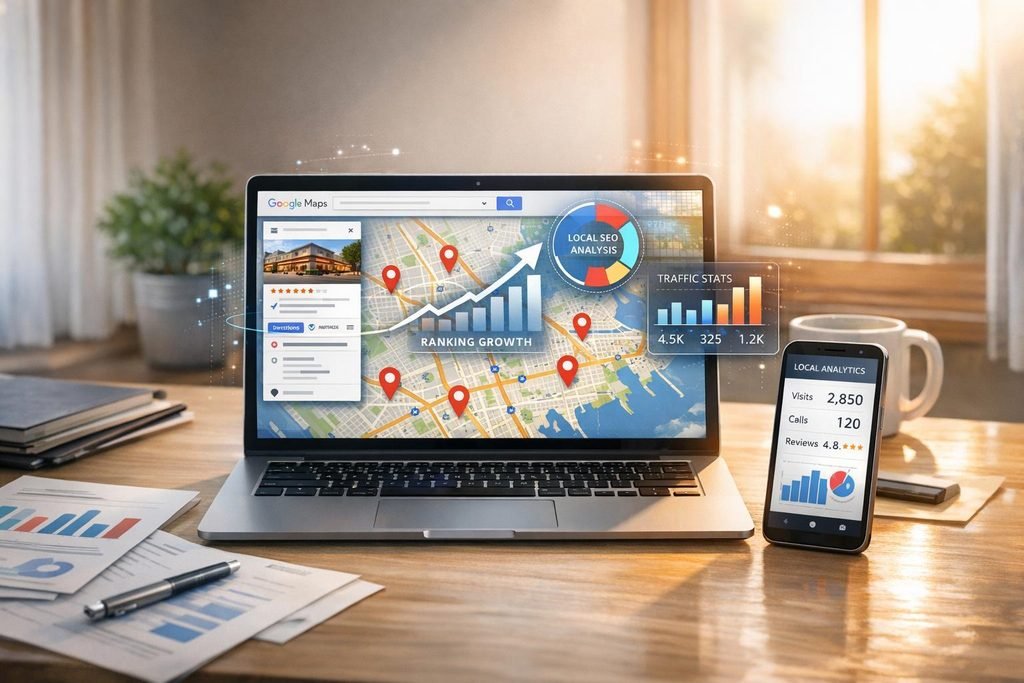
Local SEO for Beginners is an essential guide for small business owners who want to improve their online visibility. By using local SEO strategies, you can rank higher in local search results, attract nearby customers, and grow your business online.
Have you ever searched for “best bakery near me,” “digital marketing agency in Kerala,” or “salon in Perinthalmanna” on Google?
If yes, you have already experienced Local SEO.
Local SEO helps businesses appear in search results when people look for products or services in a specific location. It is especially useful for small businesses, shops, restaurants, salons, clinics, and service providers who want to attract nearby customers.
In this beginner-friendly guide, we will explore what Local SEO is, why it matters, and how businesses can improve their local online visibility.
What Is Local SEO?
Local SEO (Local Search Engine Optimization) is the process of optimizing a business’s online presence to attract more customers from relevant local searches.
For example, if someone searches for “best restaurant in Perinthalmanna,” Google may show restaurants with relevant business profiles, reviews, locations, and websites.
The goal of Local SEO is to help your business appear when potential customers search for services in your area.
Example: If you own a beauty salon in Perinthalmanna, Local SEO can help people nearby discover your salon when they search for beauty services.
Why Is Local SEO Important for Small Businesses?
Local SEO offers several benefits for businesses that serve customers in a particular area.
1. Improve Local Visibility
Local SEO helps your business appear in relevant Google Search results and Google Maps listings. This makes it easier for nearby customers to discover your services.
2. Reach Customers Who Are Ready to Buy
People searching for terms such as “near me,” “open now,” or “best service in my area” may already be looking for a business to visit or contact.
Appearing in relevant searches can help you connect with these potential customers.
3. Build Trust and Credibility
A complete business profile, accurate contact information, real customer reviews, and helpful website content can help people feel more confident about choosing your business.
4. Compete With Larger Businesses
Small businesses can improve their local visibility by focusing on relevant locations, specific services, customer experience, and accurate business information.
5. Generate More Calls and Visits
An effective local presence can encourage potential customers to call your business, request directions, visit your website, or enquire about your services.
How to Improve Local SEO: 7 Simple Steps
1. Create and Optimize Your Google Business Profile
A Google Business Profile helps eligible businesses manage how they appear on Google Search and Google Maps.
To get started:
- Create or claim your business profile.
- Use your real business name.
- Select the most relevant business category.
- Add your correct address or service area, as applicable.
- Include your phone number and website.
- Add accurate business hours.
- Upload genuine photos of your business and services.
- Keep your information updated.
A complete and accurate profile helps customers understand what your business offers and how to contact you.
2. Use Local Keywords
Local keywords include a service or product along with a location.
Examples:
- Digital marketing agency in Kerala
- Best bakery in Perinthalmanna
- Ladies’ salon in Malappuram
- Website designer near me
Use relevant local keywords naturally in your website headings, page titles, service descriptions, and blog content.
Avoid repeating the same keyword unnecessarily. Your content should be useful and easy to read.
3. Optimize Your Website for Local Search
Your website should clearly explain what your business does and which locations it serves.
Here are a few important practices:
- Add your business name and contact details.
- Create dedicated pages for important services.
- Mention your service area naturally where relevant.
- Use descriptive page titles and meta descriptions.
- Make sure your website works well on mobile devices.
- Improve website loading speed.
- Add a clear contact page with accurate information.
For example, a digital marketing professional serving businesses in Malappuram could create a page explaining their digital marketing services for businesses in that area.
Only target locations you genuinely serve, and make every location page useful and unique.
4. Collect Genuine Customer Reviews
Customer reviews can influence how people evaluate a local business. They can also contribute to local search visibility.
To encourage reviews:
- Ask satisfied customers to share honest feedback.
- Make it easy for customers to find your review link.
- Respond politely to positive and negative reviews.
- Use feedback to improve your products or services.
Never buy fake reviews or offer incentives in exchange for reviews where Google’s policies prohibit them. Authentic customer feedback is more valuable for building long-term trust.
5. Keep Your Business Information Consistent
Your business name, address, and phone number should be accurate across your website and relevant online directories.
For example, avoid listing different phone numbers or outdated addresses on different platforms.
Check your details on:
- Your website
- Google Business Profile
- Relevant local directories
- Business social media pages
Consistency helps customers contact the right business and reduces confusion.
6. Create Local Content
Publishing useful content about your service area can help you connect with local audiences.
Here are some content ideas:
- A guide to choosing the best service in your town
- Common problems local customers face
- Answers to frequently asked questions
- Local event updates relevant to your business
- Case studies featuring real projects and customers, with permission
- Tips related to your industry and service area
For example, a digital marketer could publish a blog titled “How Small Businesses in Kerala Can Improve Their Online Presence.”
The key is to provide genuine value instead of creating repetitive pages just to target different locations.
7. Track Your Local SEO Performance
Local SEO takes time, so it is important to measure your progress.
Useful tools include:
Google Business Profile Performance: Review available data about searches, website clicks, calls, and other customer interactions.
Google Search Console: Monitor website search queries, impressions, clicks, and search performance.
Google Analytics: Understand how visitors interact with your website and which channels bring traffic.
Review your results regularly and improve the pages or business information that need attention.
Local SEO vs Traditional SEO
Both Local SEO and traditional SEO aim to improve visibility in search engines, but they often focus on different goals.
| Feature | Local SEO | Traditional SEO |
|---|---|---|
| Main goal | Attract relevant local customers | Attract relevant search traffic more broadly |
| Target audience | People in a specific location or service area | People searching from various locations |
| Common example | “Dentist in Malappuram” | “How to maintain healthy teeth” |
| Key activities | Business profile, local reviews, local pages | Content optimization, technical SEO, backlinks |
| Useful for | Local shops and service businesses | Blogs, online stores, publishers, and many other websites |
A business can use both approaches depending on its audience and goals.
Common Local SEO Mistakes to Avoid
Avoid these mistakes when improving your local search presence:
- Incomplete business information: Missing contact details or outdated opening hours can confuse customers.
- Keyword stuffing: Repeating location names unnaturally can make content difficult to read.
- Ignoring reviews: Not responding to customer feedback can weaken customer relationships.
- Creating duplicate location pages: Similar pages with little unique value may not help users.
- Using fake business details: Incorrect addresses or misleading information can damage trust and violate platform policies.
- Ignoring mobile users: Many people search for local services on smartphones, so your website should be mobile-friendly.
- Expecting instant results: Local SEO performance can change over time and depends on competition, relevance, distance, and other factors.
How Long Does Local SEO Take to Show Results?
Local SEO does not have a fixed timeline. Some improvements, such as correcting your business hours or adding missing information, can help customers immediately.
However, noticeable changes in search visibility may take weeks or months, depending on your competition, website quality, location, and the work you complete.
The best approach is to improve your online presence consistently and monitor performance rather than expecting overnight results.
Conclusion
Local SEO is an important digital marketing strategy for businesses that want to reach customers in a specific location. By optimizing your Google Business Profile, using relevant local keywords, improving your website, collecting genuine reviews, and publishing useful local content, you can strengthen your business’s online presence.
You do not need to implement everything at once. Start with accurate business information, improve your website, and track your progress step by step.
Remember: The goal of Local SEO is not just to rank higher on Google. It is to help the right customers find your business when they need your products or services.
Let’s Connect!
I’m Shamna N., an aspiring digital marketer interested in helping businesses strengthen their online presence through digital marketing and SEO.
If you want to learn more about digital marketing, explore my portfolio and connect with me.
- Email: shamnaajmal626@gmail.com
- LinkedIn: www.linkedin.com/in/shamnashamna
- Instagram: Lumixa Digital