
Introduction
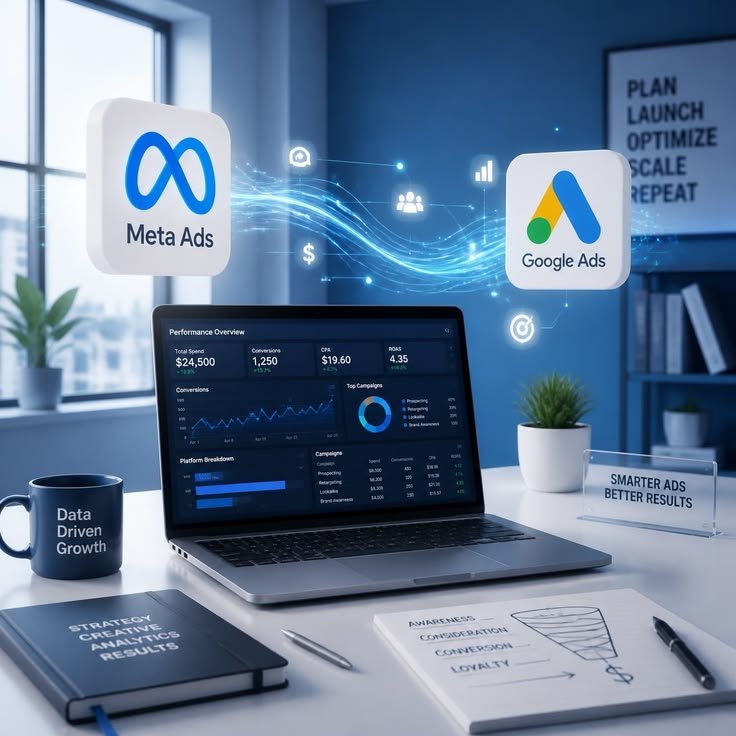
In today’s digital world, online advertising has become an important way for businesses to reach potential customers, promote products, and grow their brands. However, with so many advertising platforms available, choosing the right one can be confusing.
Two of the most popular options are Google Ads and Meta Ads. Both platforms help businesses reach their target audiences, but they work in different ways.
Google Ads helps businesses connect with people who are actively searching for products, services, or information. Meta Ads helps businesses reach people through platforms such as Facebook and Instagram, often by using their interests, behaviours, and demographic characteristics.
So, which platform is better for your business?
The answer depends on your goals, target audience, budget, and the products or services you offer. In this blog, we’ll explore Google Ads vs Meta Ads, compare their key features, and help you understand when to use each platform.
What Are Google Ads?
Google Ads is an online advertising platform that allows businesses to promote their products and services across Google’s advertising network.
One of its major advantages is the ability to reach people when they search for specific products, services, or solutions.
For example, someone searching for “digital marketing services in Kerala” may be actively looking for a professional or agency to help with their marketing needs.
Businesses can use Google Ads to show relevant advertisements to people searching for related terms.
Types of Google Ads
1. Search Ads
These text-based advertisements can appear in Google search results when people search for relevant terms. They are particularly useful for reaching people who already have an interest or need.
2. Display Ads
Display ads use images and other visual formats to reach audiences across eligible websites and apps in Google’s Display Network.
3. YouTube Ads
Businesses can use video advertisements on YouTube to introduce their brand, demonstrate products, or communicate a marketing message.
4. Shopping Ads
Shopping ads showcase product information, such as images, prices, and store details, to help online shoppers discover products.
5. Performance Max Campaigns
These campaigns use Google’s automation to distribute eligible ads across multiple Google channels based on campaign objectives and available signals.
Benefits of Google Ads
- Reaches people actively searching for relevant products or services.
- Supports lead generation, website traffic, sales, and other campaign goals.
- Provides keyword and campaign performance data.
- Offers different advertising formats for different business needs.
- Allows businesses to control budgets and adjust campaigns.
Limitations of Google Ads
Google Ads can be competitive in industries where many businesses target the same keywords. Click costs may be high for certain searches, and campaigns require relevant landing pages, effective keyword selection, and ongoing optimization.
It may also be less suitable when customers are not yet aware of a product or do not know what to search for.
What Are Meta Ads?
Meta Ads is the advertising platform used to promote businesses across Meta’s eligible platforms, including Facebook and Instagram.
Unlike search advertising, Meta Ads often reaches people while they are browsing social feeds, watching videos, or discovering content. Advertisers can use available audience targeting options and campaign objectives to reach relevant groups of people.
For example, an online jewellery store can use attractive product images, reels, and videos to introduce its collection to people who may be interested in its style.
Meta Ads can be especially useful for visual storytelling, product discovery, brand awareness, and remarketing.
Types of Meta Ads
1. Image Ads
Single-image ads are useful for highlighting products, services, offers, or important brand messages.
2. Video Ads
Video ads can demonstrate products, explain services, share stories, or capture attention through motion.
3. Carousel Ads
Carousel ads allow businesses to showcase multiple images or videos in one advertisement. They can be useful for product collections, service features, or step-by-step explanations.
4. Stories and Reels Ads
These formats allow brands to advertise through vertical visual content designed for mobile viewing.
5. Lead Ads
Lead generation ads help businesses collect information from interested prospects through supported forms and experiences.
Benefits of Meta Ads
- Helps businesses introduce products to new audiences.
- Offers visually engaging advertising formats.
- Supports brand awareness, engagement, leads, and sales.
- Can help businesses reconnect with eligible audiences who have interacted with their content.
- Provides opportunities for creative testing and audience experimentation.
Limitations of Meta Ads
People browsing Facebook or Instagram may not be actively looking to purchase a product or service. This means an advertisement may need to create interest before generating a sale.
Results can also depend on creative quality, audience relevance, campaign setup, website experience, and competition. Businesses should not assume that every campaign will produce low-cost leads or immediate sales.
Google Ads vs Meta Ads: Key Differences
Although both platforms support digital advertising, they approach audience discovery differently.
| Feature | Google Ads | Meta Ads |
|---|---|---|
| Main approach | Reaches people through search intent and other Google advertising placements | Reaches audiences through social discovery and available targeting options |
| Common platforms | Google Search, YouTube, Display Network and other eligible Google channels | Facebook, Instagram and other eligible Meta placements |
| Audience approach | Keywords, search intent, audience signals and campaign settings, depending on campaign type | Demographics, interests, behaviours and other available targeting options, depending on campaign type |
| Common strengths | Capturing existing demand and reaching people searching for solutions | Creating awareness, showcasing products and generating interest |
| Popular formats | Search text ads, display ads, video ads and shopping ads | Image ads, video ads, carousel ads, Stories and Reels ads |
| Useful for | Services, local searches, and products people actively look for | Visual products, brand discovery, audience engagement, and lead generation |
| Main consideration | Search competition and keyword costs | Creative quality and the ability to generate audience interest |
Important: These are general differences, not strict rules. Both platforms support multiple objectives, and either can work for different types of businesses.
1. Audience Intent: Search vs Discovery
One of the most important differences between Google Ads and Meta Ads is how people encounter advertisements.
Google Ads: Reach People Who Are Searching
When someone searches for a specific service, they may already have a clear need.
For example, a business owner searching for “SEO services for small businesses” may be comparing providers or preparing to contact one.
A relevant Google Search campaign can help a business appear when that demand exists.
Meta Ads: Create Interest and Awareness
People on Facebook and Instagram may be browsing for entertainment, inspiration, or updates from friends and businesses.
A visually appealing advertisement can introduce them to a product or service they were not actively searching for.
For example, a jewellery brand can use an Instagram Reel to showcase a new collection and encourage interested viewers to explore its products.
Which is better?
Google Ads may be a strong starting point when customers actively search for what you offer. Meta Ads may be a strong starting point when your product benefits from visual discovery or when you need to build awareness.
2. Which Platform Is Better for Small Businesses?
Both platforms can work for small businesses. The right choice depends on how customers discover and choose your products or services.
Google Ads for Small Businesses
Google Ads can be useful for businesses offering services that people search for directly, such as:
- Digital marketing services
- Plumbing and electrical services
- Tuition and training
- Local professional services
- Repair and maintenance
A well-targeted search campaign can help connect these businesses with people who already need their services.
Meta Ads for Small Businesses
Meta Ads can be useful for businesses that benefit from visual content and audience discovery, such as:
- Jewellery and fashion brands
- Beauty salons
- Restaurants and cafés
- Handmade product businesses
- Online stores
Businesses can use product photography, short videos, customer stories, and promotional content to introduce their offerings.
However, these are examples rather than fixed rules. A jewellery business may benefit from Google Shopping or Search Ads, while a service business may generate valuable leads through Meta Ads.
3. Google Ads vs Meta Ads: Which Is More Affordable?
There is no universal winner when it comes to advertising costs.
The amount you spend depends on factors such as your industry, competition, target audience, location, campaign objective, ad quality, and conversion performance.
Google Search campaigns may become expensive when many advertisers compete for valuable keywords. Meta campaigns may generate inexpensive clicks or engagement without necessarily producing equally inexpensive customers.
For this reason, the cheapest click is not always the best result.
Consider these metrics when comparing advertising performance:
- CPC (Cost Per Click): The average cost for each click.
- CPL (Cost Per Lead): The average cost of generating a lead.
- CPA (Cost Per Acquisition): The average cost of acquiring a customer or completing a defined action.
- ROAS (Return on Ad Spend): The revenue attributed to advertising compared with the advertising cost.
For example, Campaign A may generate leads for ₹200 each, while Campaign B generates leads for ₹300 each. If Campaign B’s leads are much more likely to become paying customers, it could deliver better business value.
Always compare campaigns using the same goal and a consistent measurement approach.
4. Which Platform Is Better for Brand Awareness?
Brand awareness means helping people discover and recognize your business.
Meta Ads can be useful for this goal because images, videos, Stories, and Reels allow brands to introduce their personality and products to relevant audiences.
For example, a new fashion brand can use short videos to demonstrate different outfits and communicate its style.
Google Ads can also support brand awareness through eligible Display, YouTube, and other campaign formats. Search Ads can help businesses become visible when people look for relevant products or services.
The best choice depends on where your audience spends time and how your message is most effectively communicated.
5. Which Platform Is Better for Lead Generation?
Lead generation involves attracting potential customers and encouraging them to express interest in your business.
Google Ads may be effective when people actively search for a solution. A relevant search advertisement can direct them to a service page where they can submit an enquiry.
Meta Ads can support lead generation through lead forms, messaging experiences, or landing pages, depending on the campaign setup.
For example, a digital marketing agency could use Google Search Ads to reach people looking for marketing services and Meta Ads to promote a free consultation to a relevant audience.
To improve lead quality on either platform:
- Clearly explain what you offer.
- Use a relevant landing page or lead form.
- Ask appropriate qualifying questions.
- Respond to enquiries promptly.
- Track which leads become actual customers.
The number of leads alone does not determine success. Lead quality and the cost of acquiring customers also matter.
6. Can You Use Google Ads and Meta Ads Together?
Yes. For some businesses, combining both platforms can create a more complete marketing strategy.
Rather than treating them as competitors, consider how they can support different stages of the customer journey.
For example:
Step 1: Introduce Your Brand
Use Meta Ads to show relevant audiences your products, services, or brand story.
Step 2: Capture Existing Demand
Use Google Search Ads to reach people actively searching for the products or services you offer.
Step 3: Reconnect With Interested Visitors
Where consent, platform policies, and available tracking options permit, use eligible remarketing campaigns to reconnect with people who have previously interacted with your business.
Step 4: Measure Business Results
Review leads, purchases, acquisition costs, and other relevant outcomes to understand how your campaigns contribute to business goals.
This approach can help businesses connect awareness and demand capture. However, it is not necessary for every business to use both platforms immediately.
If your budget is limited, start with the platform that best matches your immediate business goal. Expand after you have learned what works.
7. How to Choose the Right Advertising Platform
Before investing in paid advertising, ask yourself these five questions.
Question 1: What Is My Main Goal?
Are you trying to increase awareness, generate leads, sell products, or attract website visitors? Choose a campaign type that supports your goal.
Question 2: How Do Customers Find My Business?
If customers search Google when they need your service, Search Ads may be useful. If they discover products through social media, Meta Ads may offer valuable opportunities.
Question 3: Does My Product Need Visual Demonstration?
If your product looks appealing in images or videos, Meta Ads may help communicate its value. If customers need to find a specific service quickly, Google Search Ads may be a suitable option.
Question 4: What Is My Budget?
Choose a test budget you can afford. Consider not only the advertising spend but also the costs of creative production, landing pages, and campaign management.
Question 5: How Will I Measure Success?
Decide which metrics matter before launching. Depending on your goal, these might include qualified leads, sales, conversion rate, customer acquisition cost, or return on ad spend.
Answering these questions helps you make a more informed decision instead of choosing a platform simply because it is popular.
Common Advertising Mistakes to Avoid
Whether you choose Google Ads, Meta Ads, or both, avoid these common mistakes:
1. Running Ads Without a Clear Goal: Define the desired outcome before launching a campaign.
2. Targeting the Wrong Audience: Make sure your campaign settings and message match the people you want to reach.
3. Ignoring the Landing Page: A relevant, easy-to-use landing page can make the journey from ad click to conversion smoother.
4. Focusing Only on Clicks: Measure meaningful outcomes, not just traffic or engagement.
5. Making Changes Too Quickly: Allow sufficient time and data to evaluate performance before making major decisions, while addressing clear technical issues promptly.
6. Expecting Guaranteed Results: Advertising performance varies. Test, measure, and improve rather than assuming every campaign will succeed.
Conclusion: Which Is Right for Your Business?
Google Ads and Meta Ads both offer valuable opportunities, but the right choice depends on your business goals, target audience, budget, and customer journey.
Choose Google Ads when reaching people actively searching for your products or services is a priority. Consider Meta Ads when you want to introduce your brand, showcase products visually, or generate interest among relevant audiences.
If your budget and resources allow, using both platforms can help you reach people at different stages of their decision-making journey.
The most important thing is to focus on your business outcomes. Test your approach, monitor performance, and invest in the strategies that deliver meaningful results.
Remember: Successful digital advertising is not about choosing the most popular platform. It is about choosing the right strategy for the right audience.
Let’s Connect!
I’m Shamna.N, an aspiring digital marketer from Perinthalmanna, Kerala, currently studying digital marketing at Placementor.
I’m passionate about digital advertising, social media marketing, SEO, and content creation. I enjoy learning how businesses can use digital platforms to connect with their audiences and strengthen their online presence.
If you’re a business owner looking to explore digital marketing opportunities, let’s connect and discuss your goals.
Email: shamnaajmal626@gmail.com
LinkedIn: www.linkedin.com/in/shamnashamna
Instagram: Lumixa Digital